THE NEIGHBORS KNEW WHERE HE LIVED
How reading an 1880 census sideways helped locate a landless laborer in Jacobs Creek, Pennsylvania.
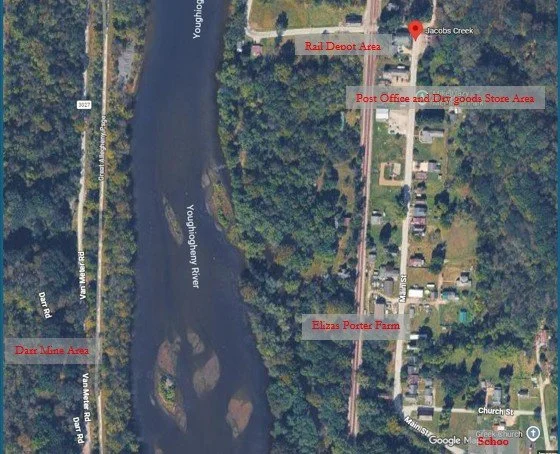
Jacobs Creek, Pennsylvania
The Youghiogheny River and the small community where census and railroad evidence placed John Gowton in 1880.
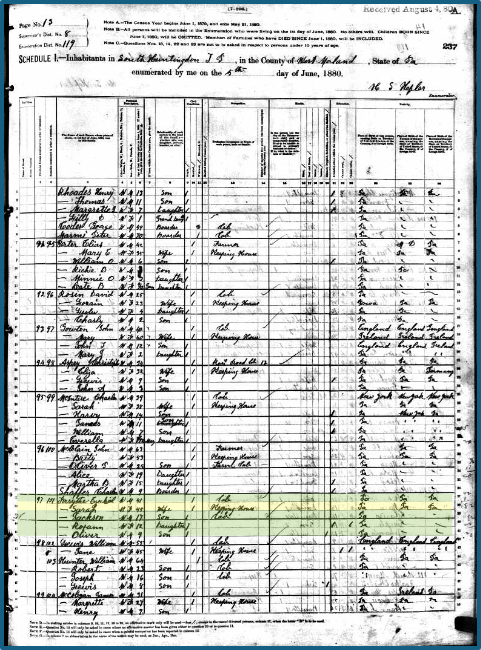
1880 U.S. Census
John Gowton appears among the South Huntingdon Township households. His neighbors provided the clues that helped identify his location.
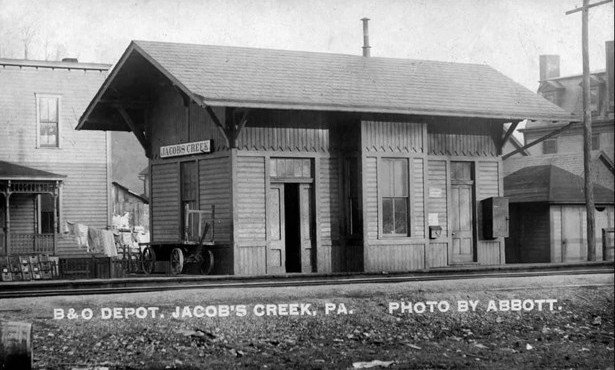
B&O Depot at Jacobs Creek
The railroad station that helped turn the occupations recorded on the census into a recognizable community.
Originally shared with Gowton Family Ancestry
Facebook · July 28, 2026
The Neighbors Knew Where He Lived
A genealogy lesson: how to read a census sheet sideways — and why the best clues hide where you'd never think to look
Some research days give you a fact. Once in a while a day gives you a whole place — and today was one of those. I want to walk through it, because if you're just starting out in family history, the day holds a lesson worth more than the discovery itself.
One line, and a wall
Here is where I began: a single line on the 1880 census for South Huntingdon Township, Westmoreland County, Pennsylvania. "John Gowton — Laborer." My great-great-grandfather. No street, no house number. Out in the countryside in 1880 the census didn't record addresses, and John owned nothing — no deed, no tract, no property to trace. A laborer who rents leaves almost no paper behind.
For a beginner, this is the classic brick wall: I know he was there. I can't find where. The temptation is to stare at your ancestor's line until you give up. The trick is to stop looking at him.
Read the neighbors
A census sheet is not a list. It's a walk. The enumerator went house to house in order, writing families down as he reached them — so the people just above and below your ancestor were his real neighbors, standing near him on the ground. And the census gives each man's occupation. Put those two facts together and the page turns into a map.
So I read the whole neighborhood instead of just my man. Around John were farmers — Porter, McClain, Hough, Aspey, Roads. But threaded among them were other trades: a railroad laborer, then a railroad agent; a dry-goods merchant; a blacksmith; a shoemaker. And here is the part that made me sit up — not one miner, not one coke worker on the entire page.
That absence was evidence. This is coal-and-coke country, but a page with no miners on it in 1880 told me the coke boom hadn't reached this exact spot yet. The occupations painted a portrait all by themselves: a small farm-and-railroad village, built around a store and a depot. And a railroad agent — a man who staffs a station — meant there was a depot right here, a fixed point I could try to find.
Let the map narrow it
Then I looked up the railroads. Only one line ran through that township — the B&O along the Youghiogheny River, on the western edge, past West Newton. The coke railroads that fed the mines ran through the next township over. So my little village, with its agent and its store, had to be down on the river, on the west side. In one step I'd gone from "somewhere in a forty-six-square-mile township" to "a particular station-hamlet on the Yough." The neighbors had walked me most of the way home.
The clue that came from a stranger
Here is the part I most want a beginner to hear, because it's the heart of the whole thing: the record that confirmed everything had nothing to do with my family.
Two of those neighbors were the merchant, Oliver Shupe, and the railroad agent, William Pore, sitting a few doors apart. On a hunch, I went looking for them — and found William Pore's obituary from 1909. It said, plainly, that he had once kept a general store in partnership with his brother-in-law, Oliver Shupe, and later became the B&O ticket agent — all in a place it named outright: Jacobs Creek.
There it was. The store and the depot from my census page, two brothers-in-law, in a named village at the mouth of Jacobs Creek. A stranger's obituary, written to honor him, had just told me where my ancestor lived. John Gowton lived at Jacobs Creek in 1880 — and I could now say it not as a guess but as a confirmed fact.
There was even a bonus, from another place I'd never have thought to look. A modern sheriff's-sale notice, for a family I'm not related to at all, happened to mention a subdivision called "Livingood's Addition" — carrying the very name of the man who, years later, would take John's land at a sheriff's sale farther up the creek. The ground still wears his name today. But that's a story for another post.
What today can teach you
If you're beginning this hobby, take these home. They are the whole method in miniature:
When a record won't give you the thing, ask what it gives you sideways. No address? The neighbors have one.
Neighbors are evidence. The enumerator's route plus the column of occupations turns a flat census sheet into a map of a real place.
Absences speak. The missing miners told me as much as the farmers did.
The best clues hide in records that aren't "yours." An obituary for a man I've never been related to solved my problem. Read widely — chase the neighbors, the storekeeper, the whole village, not just your own surname.
Stack the small facts. No single dramatic find cracked this. Occupations, then railroads, then a store, then an obituary, then a post-office date — each one only a pebble, but together a village.
Luck favors the prepared. That obituary only meant something because I'd already pinned Shupe and Pore by their trades. Do the groundwork, and you'll recognize the gift the moment it lands.