The Ground Remembers
A Family, a Coke Region, and the Search for an Unmarked Grave
What begins as the search for one forgotten immigrant family becomes a journey through Yorkshire villages, Pennsylvania mining towns, industrial labor, faith, loss, and resilience.
The Ground Remembers is more than a family history. It is an exploration of how ordinary lives become part of extraordinary history—and why preserving those stories matters
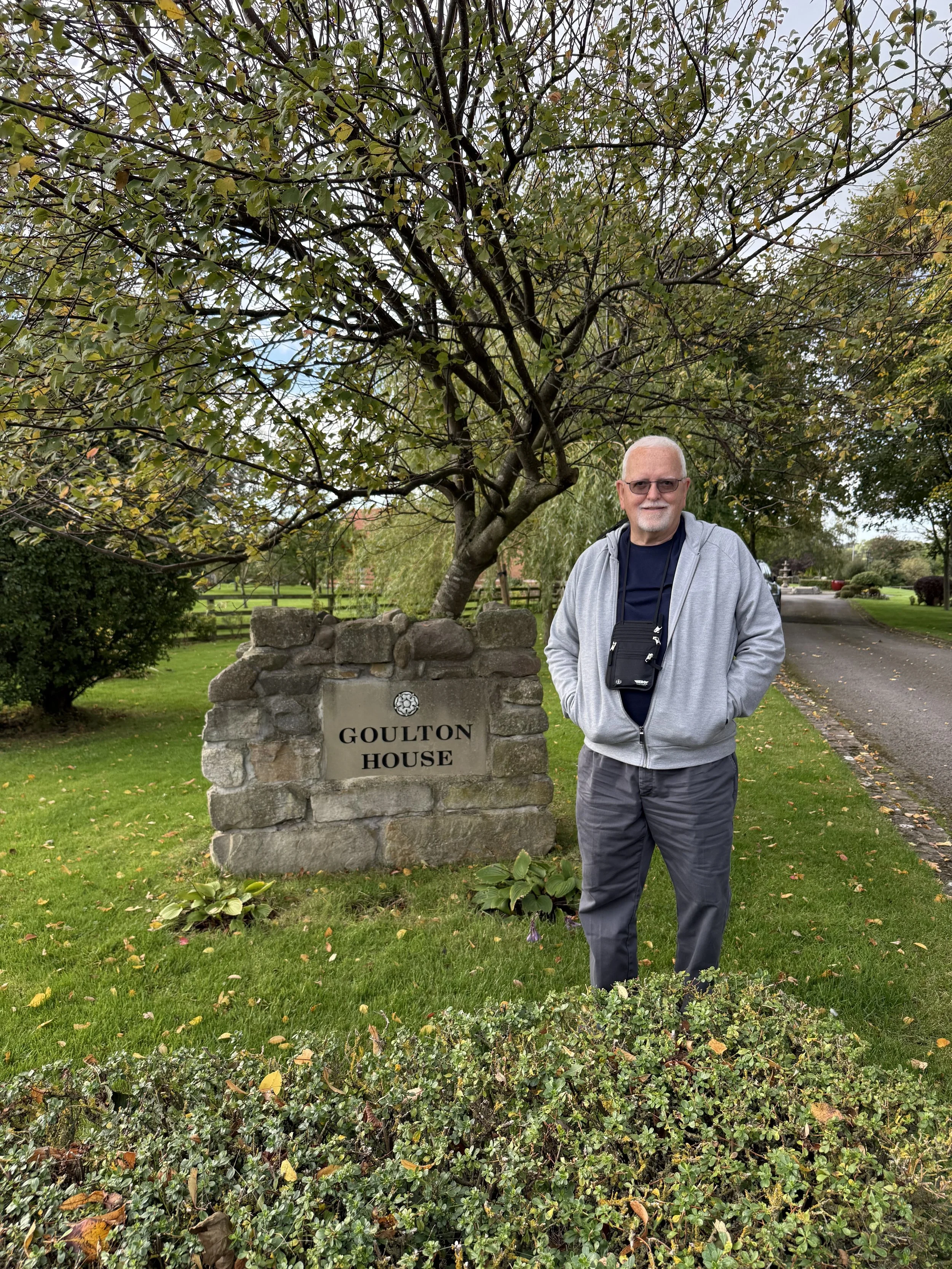
Author at Goulton House, Yorkshire, England.
Standing where the family name endured long before the journey to Pennsylvania began. Visiting places like this transformed names in old parish registers into real landscapes and real lives
Why I Wrote This Book
In 1977, my grandmother made a simple remark about our family that stayed with me for decades. What seemed like an ordinary conversation eventually became the beginning of a journey across two continents and more than two centuries of history.
I began searching for one forgotten ancestor. Instead, I discovered the lives of miners, coke workers, immigrant families, parish communities, and ordinary people whose stories had nearly disappeared from the historical record.
The Ground Remembers is my attempt to preserve those stories—not only for my family, but for anyone who believes history is built one ordinary life at a time.
Research Continues
The publication journey has become inseparable from the research journey.
Since early manuscript submissions, new records, family connections, and historical context have continued to emerge, reshaping portions of the story and strengthening others.
What began as an effort to document one family's migration from Yorkshire to Pennsylvania has evolved into a broader exploration of labor history, industrial communities, faith networks, and historical memory.
The manuscript continues to grow alongside the research, reminding me that history is rarely finished and that discovery often arrives when we least expect it.
The Publishing Journey
The Ground Remembers began as what I believed was a memoir. Early submissions taught me an important lesson: genre matters.
While the manuscript contains family history and personal discovery, its true home may be closer to narrative history, labor history, or historical nonfiction.
One early submission resulted in a thoughtful response from an acquisitions editor who, while declining the manuscript, suggested several publishers whose interests aligned more closely with the work.
The experience reinforced an important lesson for aspiring authors: read submission guidelines carefully and understand how publishers define genre and audience.
Sometimes a rejection is not an ending, but a redirection.
Recent Discoveries
One of the most significant recent discoveries involves two previously unknown children of John and Mary Elizabeth Gowton.
Records now confirm that before the family emigrated, they lost two children in Durham, England, in 1867. John Gowton, born in 1866, died in infancy. Elizabeth Ann Gowton, born about 1865, was buried on 28 October 1867 at Etherly, Durham, at approximately two years of age. That same year, on 2 December 1867, John Thomas Gowton — who would live to 1930 — was born.
To lose two small children and welcome a third within a single year is a stark reminder of the realities faced by many nineteenth-century immigrant and working-class families. It is also, in its way, the beginning of this book's subject: lives that entered the record only briefly, and might have vanished from memory altogether.
Research continues as additional records are sought
More Discoveries
Since traveling to southwestern Pennsylvania earlier this month 8/3/26 to 8/6/2026:
Jennie's Will
A significant document has surfaced: the 1900 will of Mary Jane "Jennie" Gowton Roadman, recorded in the Fayette County Register of Wills. Widowed young when her husband died in a railroad accident, Jennie left fifteen hundred dollars and the remainder of her estate to her mother, Mary Elizabeth Gowton, and named Father Michael A. Lambing guardian of her infant son.
The will answers a question the family story had long left open: how the household survived after so many losses. The bequest allowed Mary Elizabeth to raise her orphaned grandson for six years, until early 1907. It also confirms, in Jennie's own words, the guardianship arrangement that shaped the boy's childhood.
Locating the Family: Jacobs Creek
Census and mapping research has placed the family more precisely than earlier records allowed. In 1880 they were living in the Jacobs Creek area of South Huntingdon Township, Westmoreland County — within the industrial corridor of coke works and rail lines that defined their working lives.
Following the Enumerator's Path
One method has proven especially useful: tracing the route the 1900 census enumerator walked, household by household, to place the family within their actual neighborhood. By reconstructing that path and matching it against period maps, it becomes possible to narrow down where the family truly lived — and, in this case, to suggest they may have rented adjacent to the Valley Patch rather than in company housing itself. This work is ongoing, and parcel confirmation is pending with the Fayette County Recorder of Deeds.
Deeds and a Sheriff's Sale
Research now underway with the Fayette County Recorder of Deeds aims to locate the specific parcels connected to the family's residence and to a sheriff's sale in the record. These property records, once confirmed, will help fix where the family lived and how their circumstances shifted over time. Findings will be posted here as they are verified
FOLLOW THE PROJECT
Interested in family stories, historical discoveries, and the research behind them? Follow The Keith Gowton Project as the journey continues.